One tweet. Four clues.
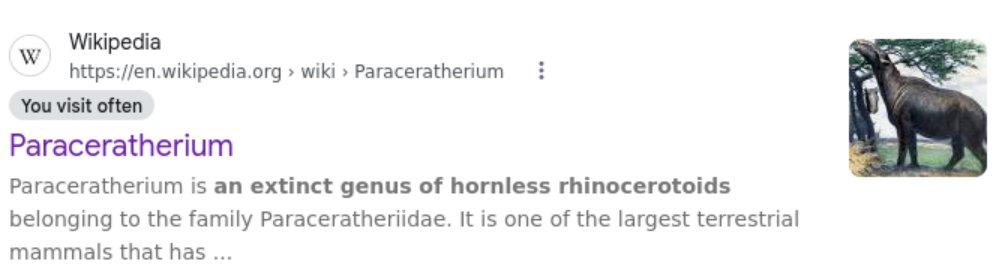
On 27 November 2026, Vitalik Buterin posted two words and a screenshot of a Google result. The two words were “TIL: rhinodinos”. The screenshot said rather more than he meant it to.
“Today I learned”
That is what TIL means. Vitalik says he discovered the rhinodino today.
You visit often
Google only shows this label on pages you keep going back to. It sits right above the result in his own screenshot.
The link is purple
Blue means new. Purple means already clicked. The Paraceratherium link in the screenshot is purple.
Straight to the source
The result is the Wikipedia article itself: “an extinct genus of hornless rhinocerotoids… one of the largest terrestrial mammals that has…”
He didn't learn it today. He's been visiting.
The founder of Ethereum keeps returning to one page about a 20-tonne hornless rhino. The community took the hint, and Paraceratherium came back from 23 million years of extinction, this time on Ethereum.
Meet the rhinodino
Paraceratherium is an extinct genus of hornless rhinocerotoids, and one of the largest land mammals that has ever existed. It lived across Eurasia during the Oligocene. These are the numbers scientists currently work with.
How big is that, really?
Shoulder height, to scale. The head rode well above this on a two-metre neck.
Extinct for 23 million years. Loud again.
Nobody knows what a Paraceratherium sounded like. No recordings survive from the Oligocene. This is our best guess, under an Ethereum moon.
From the Oligocene to the timeline
It took humans about 160 years to work out what this animal was, and they gave it four different names along the way.
The rhinoceros family tree begins. Its early members range from the size of a dog upwards, and most of them have no horns.
Paraceratherium appears and spreads across Eurasia, from China and Mongolia to Pakistan, Kazakhstan, Turkey and the Balkans.
The giants disappear. Nobody knows exactly why. They vanish around the time new large herbivores and predators arrive in Asia.
A soldier named Vickary collects the first fragments in Balochistan. Nobody can tell what they are.
British geologist Guy Pilgrim finds a jaw and teeth at Dera Bugti, in what is now Pakistan, and files them under a known hornless rhino.
Clive Forster-Cooper digs up more and gives it its own name: Paraceratherium, “near the hornless beast”.
In Kazakhstan, Russian scientists find the most complete skeleton yet and call it Indricotherium, after the Indrik, a mythical monster of Russian folklore.
Roy Chapman Andrews' expedition finds one in the Gobi Desert with its legs still standing upright. It had died trapped in quicksand.
A new species, Paraceratherium linxiaense, is described from a complete skull found in north-western China.
Vitalik posts “TIL: rhinodinos” with a screenshot that reads “You visit often”. Within minutes, Paraceratherium is live on Ethereum.
Built like Ethereum
Of all the animals to keep rereading about, this is a fitting one.
The biggest on land
Scientists think about 20 tonnes may be the upper limit for a land mammal. Paraceratherium got closer to it than almost anything else.
No horn, no problem
It is a rhino that never needed a horn. Most predators around it were no bigger than a wolf, so adults had very little to fear.
Reaches the top branches
It browsed leaves from tall trees that nothing else could reach, like a giraffe built from rhino parts.
Slow, and goes far
Too big to run, built to walk. It crossed huge distances and spread across a whole continent despite seas in the way.
Many names, one beast
Baluchitherium, Indricotherium, Thaumastotherium (“wonderful beast”). In the end they all turned out to be Paraceratherium.
Vitalik reads up on it
Often, says Google. That part is in the screenshot.
A rhinodino is not a dinosaur. It is a mammal and a relative of today's rhinos. It lived more than 30 million years after the dinosaurs died out.
Nobody knows its colour. No skin has ever been found. The grey, wrinkled hide in every picture is an educated guess.
It probably had a grabbing lip. The shape of its nose bones suggests a flexible upper lip or a short trunk for stripping branches.
Its one real enemy was a crocodile. Bite marks on bones from Pakistan point to a croc 10 to 11 metres long.
It was probably a night walker. An animal that size overheats easily, so it likely rested in shade by day and fed after dark.
It may have lived in small herds of mothers and calves, with long pregnancies and long lives, much like elephants.
Adopt a rhinodino
Get a wallet
MetaMask, Rabby or any Ethereum wallet works.
Add some ETH
You need ETH on Ethereum mainnet for the swap and for gas.
Open Uniswap
Paste the contract address below. Check it matches this site exactly.
Swap
Swap ETH for Paraceratherium and join the herd.

Join the herd
They may have travelled in small herds. Ours is on Telegram and X.